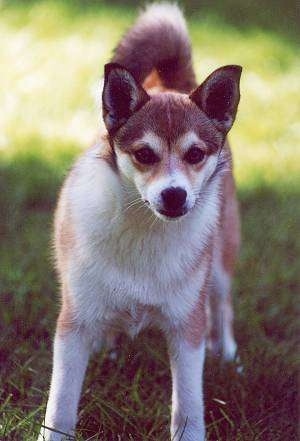
COUNTRY: Norway
WEIGHT: 13-14 pounds
HEIGHT: Ul/2~W/2 inches
COAT: Short, rough, stand-off
COLOR: Brown with black tipping and some white markings; rare blacks or white with black tipping allowed
OTHER NAMES: Norwegian Puffin Dog
GROUP: Northern
This quaint dog is believed by some to have survived the Ice Age by feeding on sea birds. Its purity was assured by the isolation of Maastad and other Arctic islands. As early as 1591, Schonnebol told of these dogs in his travels.
The puffin (lunde) is a brightly colored bird which waddles on land, but fights fiercely to protect its young. Puffins breed in large colonies, with nests built deep in the rocky crevices on coastal islands in the Arctic seas. Nest rob-bing is only for the very brave or foolhardy person, as the birds fight desperately to protect themselves with their vicious beaks and claws. Nevertheless, the young birds were sought to be salted, preserved and eaten during Lent. It is said they tasted enough like fish to satisfy even pious consciences. The puffin down and feathers were also valued.
The puffin (lunde) is a brightly colored bird which waddles on land, but fights fiercely to protect its young. Puffins breed in large colonies, with nests built deep in the rocky crevices on coastal islands in the Arctic seas. Nest rob-bing is only for the very brave or foolhardy person, as the birds fight desperately to protect themselves with their vicious beaks and claws. Nevertheless, the young birds were sought to be salted, preserved and eaten during Lent. It is said they tasted enough like fish to satisfy even pious consciences. The puffin down and feathers were also valued.
When the fledglings were about 40 days old, the danger of the hunt was eased as the adults abandoned their young to the ways of the world. All that was left to battle was the folding, pleating and mutilating of oneself into the crevices. No human was up to that. Enter the Lundehund—physically a breed nonpareil—ideally suited to fit the job requirements.

The Puffin Dog is a typical Nordic dog, but with several modifications to fit his specialized job. His upright ears are placed so high and forward that, upon pricking them, they afford the added protection of almost closing to the front. This creates a shield from the constantly drip-ping water and dust in the caves. He is able to mold his body to fit in narrow passages because of the extraordinary range of motion in his joints. The head can be bent backwards, almost touching its back, and the forelegs can turn to the side at 90-degree angles.
The Lundehund certainly has the most interesting feet in dogdom. Small-bodied for agility among the rocks, the breed has been selected for polydactylism (supernumerary toes), so that it has at least two large functional dewclaws and up to eight plantar cushions per foot. The extra toes aid in the clamber up the rocks after the puffin. The standard states that there must be at least six toes on each foot and, of those, at least five toes on the forefoot and four on the hind foot should support the dog. On the front paw, five of those toes are triple-jointed, similar to our fingers, and one toe is double-jointed. Four toes on the rear foot have three joints, and one is split into two digits, each with two joints, all giving the dog incredible grasping abilities, even on the rocky climbs. These characteristics must be on the judging table during competition. Parson Petter Dass (1647-1708) wrote of the puffin hunt in a poem, Nordlandstrompet:
"A puffin hatches an only egg,
it is hidden in the scree as inside a wall
in the innermost caves of the rocks.
A nest is built so near the other,
that one bites the other's wing and feather
in the crevices, where they hide.
But the farmers who have a plan
know well to intrude upon those puffins
with loot,
and that by trained dogs,
which by formation are supple and small,
so they can creep into the narrowest nook
and pull out live puffins.
When the dog snatches that puffin by the
neck, which lies in front, whose life is for sale,
it begins straightway to set out.
At once the puffin, which sat behind
grasps the foremost by the tail and goes
together, whereas one is left behind.
By this it happens that a single dog
drags out at once from the darkest ground
twelve, thirteen—even fourteen and more,
and supplies its awaiting master
with so much booty, as he can handle,
whereby his profit may flourish."
it is hidden in the scree as inside a wall
in the innermost caves of the rocks.
A nest is built so near the other,
that one bites the other's wing and feather
in the crevices, where they hide.
But the farmers who have a plan
know well to intrude upon those puffins
with loot,
and that by trained dogs,
which by formation are supple and small,
so they can creep into the narrowest nook
and pull out live puffins.
When the dog snatches that puffin by the
neck, which lies in front, whose life is for sale,
it begins straightway to set out.
At once the puffin, which sat behind
grasps the foremost by the tail and goes
together, whereas one is left behind.
By this it happens that a single dog
drags out at once from the darkest ground
twelve, thirteen—even fourteen and more,
and supplies its awaiting master
with so much booty, as he can handle,
whereby his profit may flourish."