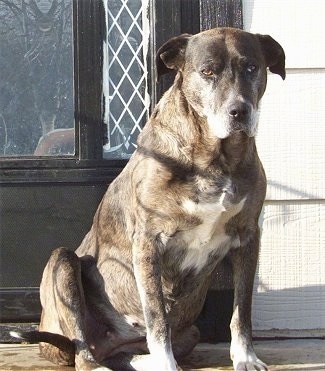
The Louisiana Catahoula Leopard Dog or Catahoula Cur, is named after Catahoula Parish in the state of Louisiana in the United States. Of remaining dog breeds, the Catahoula is believed to have occupied North America the longest, aside from the dogs descended from Native American-created breeds. The breed is sometimes incorrectly referred to as the "Catahoula Hound" or "Catahoula Leopard Hound", as it is not a hound, but a Cur.
History
One theory as to the origins of the breed states that the Catahoula is thought to have descended from "war dogs" (Mastiffs and Greyhounds) brought to Louisiana by Hernando de Soto in the 16th century. Dogs left behind by the explorer's party were interbred by the local natives with their domestic dogs.
The idea that Native Americans bred their dogs with or from red wolves is not supported by recent DNA work. Several recent studies,[1] have looked at the remains of prehistoric dogs from American archaeological sites and each has indicated that the genetics of prehistoric American dogs are similar to European and Asian domestic dogs rather than wild New World canids. In fact, these studies indicate that Native Americans brought several lines (breeds) of already domesticated dogs with them on their journeys from Asia to North America..
There is a plethora of published sources detailing the domestic dogs found in prehistoric archaeological sites. Clearly, the red wolf was not the only canid located in the Mississippi River Valley before the arrival of Europeans. There were also foxes and grey wolves as well as various domesticated Native American breeds.
In the 1800s, French settlers arrived in Louisiana with their Beauceron. They told of strange looking dogs with haunting glass eyes that were used by the Indians to hunt game in the swamp. It is thought the Beauceron and Red Wolf/war dog were interbred to produce the Catahoula. The word 'Catahoula' is actually a combination of two Choctaw words 'okhata', meaning lake, and 'hullo', meaning beloved... or a French transformation of the Choctaw Indian word for their own nation, 'Couthaougoula' pronounced 'Coot-ha-oo-goo-la'.(Don Abney)
Jim Bowie and brother Rezin Bowie, who spent much of their youth in Catahoula Parish are reported to have owned a pair of Catahoulas. It was said that they would sleep with a Catahoula at their feet. During the early 1900s, Teddy Roosevelt used the Catahoula when hunting. Louisiana Governor Earl K. Long had an interest in the breed and collected them. This interest was recognized by an annual competition known as Uncle Earl's Hog Dog Trials.
In 1979, Governor Edwin Edwards signed a bill making the Catahoula the official state dog of Louisiana in recognition of their importance in the history of the region.
In 2007, the Catahoula was voted to be the school mascot for Centenary College of Louisiana.
Apperance
The breed's size ranges from 20-26" and weighs between 50-90 lbs, with a few individuals larger. Most males average 60-70 lbs in lean working condition and are about 24" tall. As a working dog, Catahoulas have been bred more for temperament and ability than for appearance. As a result, the physical characteristics of the Catahoula are somewhat varied.

Coat
Catahoulas Leopards have a single, short, dense coat in a variety of colors. These dogs are actually solid colored dogs that have been affected by the merle gene which dilutes a normally dark coat. This merle gene combines with solid colors to create merle patterns in patches of white and colored hairs intermingled with patches of solid colors.
Leopards with black coats will appear with patches of blue or gray. Likewise, Leopards with red and brown coats will appear with lighter patches of red or liver. This occurrence is referred to as a Leopard (Merle) colored dog. The merle gene does not normally affect the entire coat of the dog, but dilutes the color only in areas that are randomly selected by the gene. White coats are visually unaffected.
Texture
The texture of a Catahoula Leopard coat can be as varied as the colors and can be painted on coats, slick, coarse, or shaggy, wooly coats.
* Coarse coat: This coat is a little longer and fuller than others. They do not require that much maintenance, however, these dogs are not quick to dry when wet. These coats will often display "feathers" seen on the rear legs, tail, and undercarriage.
* Slick coat: A slick, painted on coat is so slick and smooth that it appears as if the coat were painted on the dog and not hair at all. The hair is very short and lies very close to the body. These coats dry very rapidly, and because of this, the dog can be cleaned and ready in a matter of minutes and are often referred to as a "Wash n' Wear" coat.
* Wooly coat: Wooly, shaggy, and double coats are undesirable and will appear in some litters. At about 3 weeks of age, the coat will be longer and fuller and appear wooly. Most puppies will shed this for a coarse coat, however some will become double-coats. Some coats will maintain a length similar to that of a German Shepherd while others will maintain their shaggy appearance.
Color
* Black: These are leopards least affected by the merle gene but will display smaller patches of blue or gray.
* Gray: Gray leopards are black where the coat has been diluted to appear gray.
* Tri-color: Leopards with three distinct visible colors usually white, black, and gray.
* Quad-color: These are Catahoulas with the varying body colorations and trim colors that help to designate the number of colors present on the dogs. Gray Leopards may be considered a Quad-color when White and Tan trim are included. This dog would display Black, Gray, White, usually around the neck, face, feet and tail, and Tan, which may also appear around the face and feet. Most Five colored dogs are actually misnamed Quad-colored dogs.
* Patchwork: These Leopards are predominantly white dogs with small amounts of solid and/or merle patches appearing throughout the coat. The colored patches may be black, or brown. Dilution may affect those colored patches and produce gray, blue, red, or liver coloration within them.