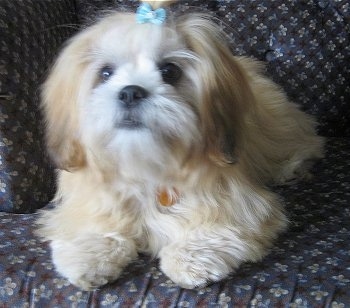
COUNTRY: Tibet (China)
HEIGHT: 10-11 inches for males, less for bitches
COAT: Heavy, straight, hard and dense
COLOR: Golden, sandy or honey (these
preferably with black tips on ear, tail and beard hair); also grizzle, slate, smoke, particolor, black, white, or brown
OTHISR NAMES: Tibetan Apso
GROUP: Herding
The power of Buddha. The god was said to have shown his complete domination over the animals by making the lion guard his temples and follow him around "like a pet dog." A leonine colored and shaped dog was a good example to show primitive people proof of this story.
Lhasas^ "lion dogs," became fixtures inside the homes of Tibetan nobility and in lamas' monasteries. Of course, the little dogs were purported to be guardians which, with their wariness to strangers and sharp bark, they probably were. But, with a Tibetan Mastiff tied outside the dwelling to provide the heavy artillery, the Apsos were mainly the beloved companions and friends of people in an inhospitable part of the world. Legend says that lamas (priests) that failed to reach Nirvana came back reincarnated as Lhasa Apsos. With this prestigious background, it is obvious why they were treated so well by the Tibetans.
The origin of the breed's name is a matter of controversy. In Tibet, the Lhasa is called abso seng kye, which indicates a barking, sentinel lion dog. Most numerous around the religious capital of Lhasa, the resulting combination might have contributed to his Western name. There are those that feel the name came from the Tibetan word rapso, which means goatlike, a description of the coat. In Britain, he is sometimes called, more generically, the Tibetan Apso.

Documented evidence exists that, for centuries, the Dalai Lamas—the spiritual heads of Tibet—sent gifts of small lion dogs to the imperial courts of China as tokens of esteem and good fortune. These dogs were incorporated into the strains of Chinese dogs and helped in the formation of breeds such as the Shih Tzu and Pekingese. The last of the Manchu empresses was known to have bred the Lhasas into her Chinese dogs "to improve coat."
Lhasa dogs began to appear in the West around the turn of the century, brought back by British explorers, emissaries and other travelers to Tibet. There was much confusion at first, with shaggy Oriental dogs of a variety of sizes being called "Lhasa Terriers." It was only later that authorities distinguished between the leggier and longer headed Tibetan Terrier and the smaller Lhasa Apso. Many early Shih Tzus also may have been a part of this confusion. But by the 1930s, the Lhasa Apso had his own identity and a supportive breed club in Britain. The breed was introduced into the United States about this same time, from an initial pair given as gifts by the 13th Dalai Lama to visiting Americans, the C. Suydam Cuttings, forming the famed Hamilton line. In fact, the dogs in Tibet were never sold, but given away to esteemed friends as good luck talismans that kept evil spirits away.

Later, when the Shih Tzu first arrived in the States, they were mistakingly registered as Lha-sas. Some of these dogs were naturally bred to Lhasas, causing a great deal of trouble between breeders. Even today one will find stress placed on the "pure Hamilton line," indicating no Shih Tzu blood flows in their veins.
The Lhasa has become a favored companion dog in many modern nations. His small—but not toy—size combined with his surprising hardiness and ability to distinguish friend from foe have endeared him to many. Owners are amazed by his ability to adapt to a variety of climatic conditions and lifestyles, but he does need human contact to fulfill his destiny. Despite their natural companionability with man, some can be a bit strong-minded, and early introduction to rules and firm, loving discipline are recommended.
They are well known for their longevity; dogs of 18 are not uncommon and one champion of this breed lived to be 29! In the show ring, the Lhasa is the ultimate in coiffed glamour, with hair completely covering his eyes and head and reaching the floor. Even those specimens intended as pets require regular grooming to prevent a disaster of tangles and mats. Due to the brachycephalic nature of their genetic background, undershot jaws are the norm.