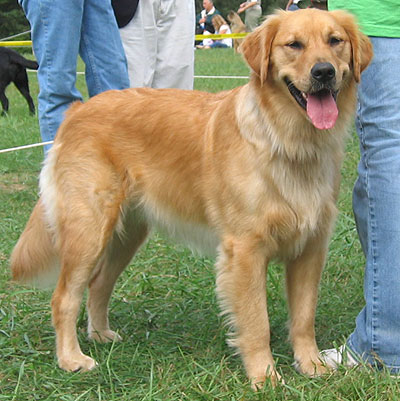
COUNTRY: Great Britain
WEIGHT: 60-75 pounds
HEIGHT: 21]/2-24 inches
COAT: Dense and water repellent, lying flat to the body, flat or wavy, with some fringes—but not silky; good undercoat
COLOR: Various shades of lustrous golden
GROUP: Gun DogThe Golden is another product from the latter half of the 19th century, when so many of the gun dog breeds were formed. The breed owes much of its development to Sir Dudley Majori-banks (Lord Tweedmouth) whose records from his own meticulous stud books give a good basis of origins. Yellow recessives had always been present in the retrievers from Newfoundland and Labrador, even though in the 1850s the fashion in England was for black "Wavy-Coats" and Labradors. Lighter hues came to prominence later in the yellow Labs, as well in as the Chessie, and then the Golden.
Majoribanks took a liking to the yellow color and acquired a dog of that color, "Nous," from Flat-Coat breeding. To create good water retrievers, Nous was bred to Tweed Water Spaniel bitches, a now-extinct English retrieving dog that was close and curly-coated and a light liver color. Other crossings, of structured linebreed-ing, were recorded over a period of 20 years, including a Labrador or two, a red setter, possibly a Bloodhound, and other Wavy-Coats.
This, then, is the basic Golden's inheritance. Goldens were registered and shown as golden Flat-Coats until 1913, when they were listed as Golden or Yellow Retrievers and, finally, in 1920, took the name they bear today.
A legend still persists about Russian Sheep-dogs, acquired from a traveling circus, that contributed to the creation of the breed. No such information has been found among the Tweed-mouth archives. Of course, others were breeding these golden-colored retrievers besides Ma-joribanks, so this strange mixture could have been introduced in other kennels. But most cy-nologists feel this was a contrived story, which the general public loved to believe. With the possible exception of trainability, the genetics of sheep dogs are diametrically opposed to the necessary abilities of the gun dog, and it is doubtful any knowledgeable dog breeder would have entertained the idea. Supporting this legend, however, the Golden was first exhibited under the name of Russian Retriever or Russian Retriever and Tracker. Thus, the story lives on.
Whatever its foundation, the modern Golden Retriever is a wonderfully versatile dog. He is a good retriever and upland game hunter, is used with increasing frequency as a guide for the blind and makes a loving, easygoing, pleasant companion. In the United States, the Golden dominates obedience competition with his flashy animation, quick reflexes, precision, trainability and intense desire to please. The same attributes stand him in good stead in the show ring.
A Golden requires sufficient exercise to overcome a tendency toward excess poundage. His beautiful coat requires only routine brushing, with a few grooming sessions during the spring when the undercoat is shed. The color can range from a soft, pale moon yellow to a lustrous burnished gold. It is as though the Golden has captured the warmth and beauty of sparkling sunshine in both his coat and temperament. He is a wonderful family pet, as he is loving and long-suffering with children, mannerly in the home, yet always ready to accompany any member in activities. A dog nearly void of guard instincts, his fringed tail always seems to be wagging. His expression is one of straightforward affection and trust.

