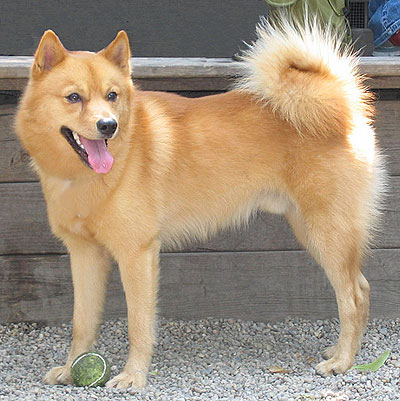
COUNTRY: Finland
WEIGHT: 25-30 pounds
HEIGHT: 15V2-20 inches
COAT: Dense, moderately short, stand-off coat
COLOR: Chestnut red to pale red-gold, lighter shades on the undersides are allowed; puppies born brown
OTHER NAMES: Suomenpystykorva, Finsk Spets, Loulou Finnois
Group:NorthernThe Finnish Spitz is an old, northern breed native to Finland, and has had a written standard since 1812! This handsome red-gold-coated Norseman is the national dog of Finland and is mentioned in several national heroic songs. Improvement of the breed was expedited in the 1890s when forester Hugo Richard Sandberg successfully campaigned to have the barking dog recognized by the Finnish Kennel Club. Writing in Sporten that year, he characterized the Finnish Spitz: "When living in close contact with a family, sharing its bright as well as cloudy days, the Finnish dog has features that resemble its owner, the Finn. The dog shows devotion and self-sacrificing faithfulness towards its master. It has also much more courage than one would expect of such a little dog. Under normal conditions it is a modest animal, but if fettered or shut into a kennel it easily becomes depressed and its fitness for use goes down. It seems to be like a pine: satisfied in poor soil with only a little food, but like a pine it demands air and freedom."
About the same time, Sandberg's cohort, Hugo Roos (another forester and hunter), was dedicated to finding and breeding typical specimens to maintain this handsome hunting dog. Titled English fanciers added support in the 1930s, particularly Lady Kitty Ritson.
In days of old, the Finnish Spitz was used by the Lapps for tracking bear and elk, but is now mainly used for bird hunting, especially caper-caillie (similar to wild turkey) and black grouse, the game birds of Finland. His nickname, the barking bird dog, comes from his unique method of hunting. His lively manner of searching and acute scenting ability lead him to birds. Then by yodeling (barking continuously), he "enchants the bird to sit in the tree and watch the dog."The dog is said to show "keen disappointment if the hunter misses. When the bird is shot the feet must be given to the dog as a prize, or legend has it, he will refuse to work for such an inconsiderate master."
Bird-hunting trials for the breed are common in Finland, and no Finnish Spitz can become a breed champion without winning a trial prize as well. The trials are set up with the judges following a dog and hunter into the forest. The dog is credited for finding and following birds, holding the bird in the tree, and the number of barks per minute (the more the better). It is claimed he must bark 160 times per minute. He is faulted for disobedience, "false barks" at a tree where there is no bird, ceasing to bark and/or leaving the bird, barking at squirrels or chasing elk or hare.
When a dog has three conformation certificates and either one first or two second prizes from a bird-hunting trial, he becomes a show champion. With a win in the open class at a bird-hunting trial and at least a second prize in a show, he becomes a trial champion. When he has won both titles, he is given the esteemed title of dual champion.
Hunting is considered so important in Finland that the status of the game bird population affects the breeding and registration of these dogs. The late 1970s were bad years for birds, and registrations of Finnish Spitz fell to their lowest level in many years. But when the bird population began recovering, interest in the red dog resumed. In 1980, registration of 1,087 Finnish Spitz was accomplished in Finland, and 116 hunting trials were held in which 579 dogs took part.
The best trial winners can compete in district championships, in the National Haukku contest, and the international contest between Finland and Sweden. Winner of the Haukku Trial is awarded the title "King of Barking" and victor of the international contest wins the crown of "Champion of The North." Breeders support these trials because of their strong desire to maintain working qualities. Because both hunting and the Finnish Spitz are essential parts of the history and culture of the Finnish wilderness, preservation and care of the breed are matters of honor for Finnish kennel clubs and Finnish hunters.
Watchful and alert, the Finnish Spitz makes a fine alarm dog, and is often kept in the home. He is built square and up on leg, with the lightness of build necessary for precise hunting. The tail comes up over the back and down the leg; it must end pressed against the thigh. The small, high-set, mobile ears are a trademark, the translation for his Finnish name, Suomenpystykorva, being Finnish cock-eared dog. In England, he is known affectionately as the "Finkie." Since vocalization is part of their genetic make-up and barking is emphasized in trials, owners must not expect a silent companion. The dogs' beauty, size and happy temperament, as well as their cleanliness, sturdiness and easy care are pluses for family dogs.
The Finnish Spitz was added to AKC's Non-Sporting Group in 1988. He is also registered in Canada (since the 70s), England ('30s), Chile, Australia and several countries in continental Europe.