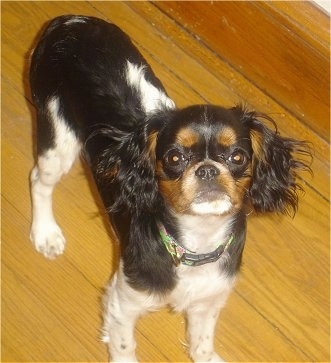
COUNTRY: Great Britain
WEIGHT: 9-12 pounds
HEIGHT: 10-10 Vi inches
COAT: Long, wavy, silky and profuse
COLOR: Tricolor (Prince Charles), solid red (Ruby), red/white (Blenheim), or black/tan (King Charles)
OTHER NAMES: King Charles Spaniel
Group:Gun DogEver since there were spaniels, toy versions have curled in laps and warmed hearts. In England and on the Continent, the charming spaniel personality in a tiny package was valued as a pet. These dogs were selected for smaller and smaller size among the existing couching and setting dogs that established the type for the spaniels. Crosses to other tiny dogs may have occurred as well, but these were basically little gun dogs. Indulged and pampered by the wealthy, they were known as "comforters." Of course, they were mostly admired just for their companionship, but they were also useful as foot warmers in cold and drafty English castles!
Those in England took on the general appearance of a small Cocker Spaniel, and were illustrated frequently in literature and paintings. A medieval scoffer described the "Spaniell gentle . . , These dogs—pretty, proper and tine to sati-sfie the delicatenes of dainty dames and wanton women's wills ..." A favorite legend tells that when Mary Queen of Scots was sent to her death in the 16th century, her executioner found one of her devoted little spaniels hidden in the folds of her skirt. To a happier end, in the late 1600s, they were favorites of King Charles II. He had many of them and they enjoyed full run of the palaces. Samuel Pepys, writing at the time, was critical of the king's devotion to them, noting that: "All I observed there was the silliness of the King playing with his dog all the while and not minding his business." Soon the little dogs were universally known as King Charles Spaniels, often referred to as Charlies.
Others who doted on the breed were noted: an advertisement appeared in the Daily Courant in 1720, promising a reward for the return of a King Charles Spaniel bitch. With a twisted sense of prideful ownership, one Duke of Norfolk would not sell or give his Toy Spaniels away, but instead fed unwanted pups to his eagles!
Over the next century or so, the "King Charles Spaniel" began to change. Crosses to toy dogs from the Orient were likely. Soon the "comforters" became even smaller, with the extreme brachycephalic face, domed head, prominent eyes, and muzzle shortened so the nose was nearly flush to the face. They still had the charming spaniel personalities within a new contour. It is this short-faced version that has arrived at the present time as the English Toy Spaniel.
During the reign of King Charles, most of the specimens were black/tan and, thus, this color has taken on the king's name. The Blenheim color was named after the family estate of the Dukes of Marlborough, whose family owned many of the red/whites over the years. All colors are otherwise judged by the same standard of perfection. When The Kennel Club tried to classify all four colors under the title "Toy Spaniel," Edward VII, also a fancier, did not approve. Therefore, the breed is still also called the King Charles Spaniel—in deference to a king.
The breed is quiet and happy, content to be with its owners, and forgiving in nature. They are physically fastidious. Protruding eyes and hanging ears must be kept scrupulously clean, but otherwise care is minimal. Tails are docked like the other spaniels, and carried level with the back. Ears and their accompanying feathering are so long as to nearly brush the ground.