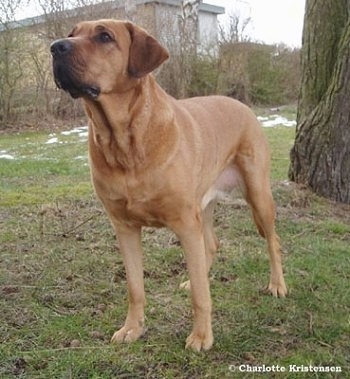
COUNTRY: Denmark
HEIGHT: 27l/2-29l/2 inches
COAT: Short, harsh
COLOR: Light or brownish yellow, black; white marking on chest, feet and tail tip allowed
GROUP: MastiffIn the past, Broholmers attracted attention from royalty and from artists, and are portrayed in paintings of the Danish Renaissance kings, Frederik II and Christian IV, Mastiffs sent by the English to Danish courts were bred with local canines, probably of the early Great Dane type, producing the Broholmer. These dogs assisted in driving cattle to market and were often called slagterhunden, the butchers' dogs.
King Frederik VII and his consort, Countess Danner, owned several Broholmers. A painting of the couple completed around 1859 shows a favorite, "Tyrk," lying at their feet; Tyrk was immortalized at his death by being "stuffed" and donated to the Copenhagen Zoological Museum. About the same time, an archeologist, Count Niels Frederik Sehested of Broholm-Funen, began collecting and organizing the breed. This major source gave the breed its modern name. The Count presented numerous puppies to others who promised to support the breed and spent decades standardizing the Broholmer, For a time, the breed enjoyed the friendship of no-bility, famed authors and commoners alike. Between the two World Wars, large dogs and their expensive feeding habits went out of fashion. Many thought this Danish dog just an antique.
Cynologist Jytte Weiss, however, stirred interest in restoring the native breed to its former status. In 1974, revival of the breed began with the Committee for National and Forgotten Breeds. The committee, appointed by the Danish Kennel Club, unearthed two quality Broholmers which matched the 1886 standard. Encouraged, committee members Weiss and Ole Staunskjar scoured the country for more, supported in their search by the press, veterinarians and dog lovers. Black variants were found in northern Seeland in the hands of peasants, farmers, lumberjacks and rangers. One of these blacks, named "Manne," became the cornerstone of the modern Broholmer.
The numbers are still not legion, but the Broholmer is gaining strength despite a narrow breed base. Breedings are still approved only through the committee. In 1982, FCI approved the standard and the breed can be exhibited in international shows.
In build, they are more elegant and not as massive as the English Mastiff, although they remain large and impressive. They have a massive, broad head, carried rather low when not alert. The chest is wide and rippling with muscles. The committee encourages the breeding of only steadfast, good-tempered dogs. These powerful dogs are naturally alert and make good watchdogs.