COUNTRY: USA
This retriever is truly an American breed from the Chesapeake Bay area. The story told is that two puppies rescued from a sinking ship became the founders of this line of rugged water retriever.
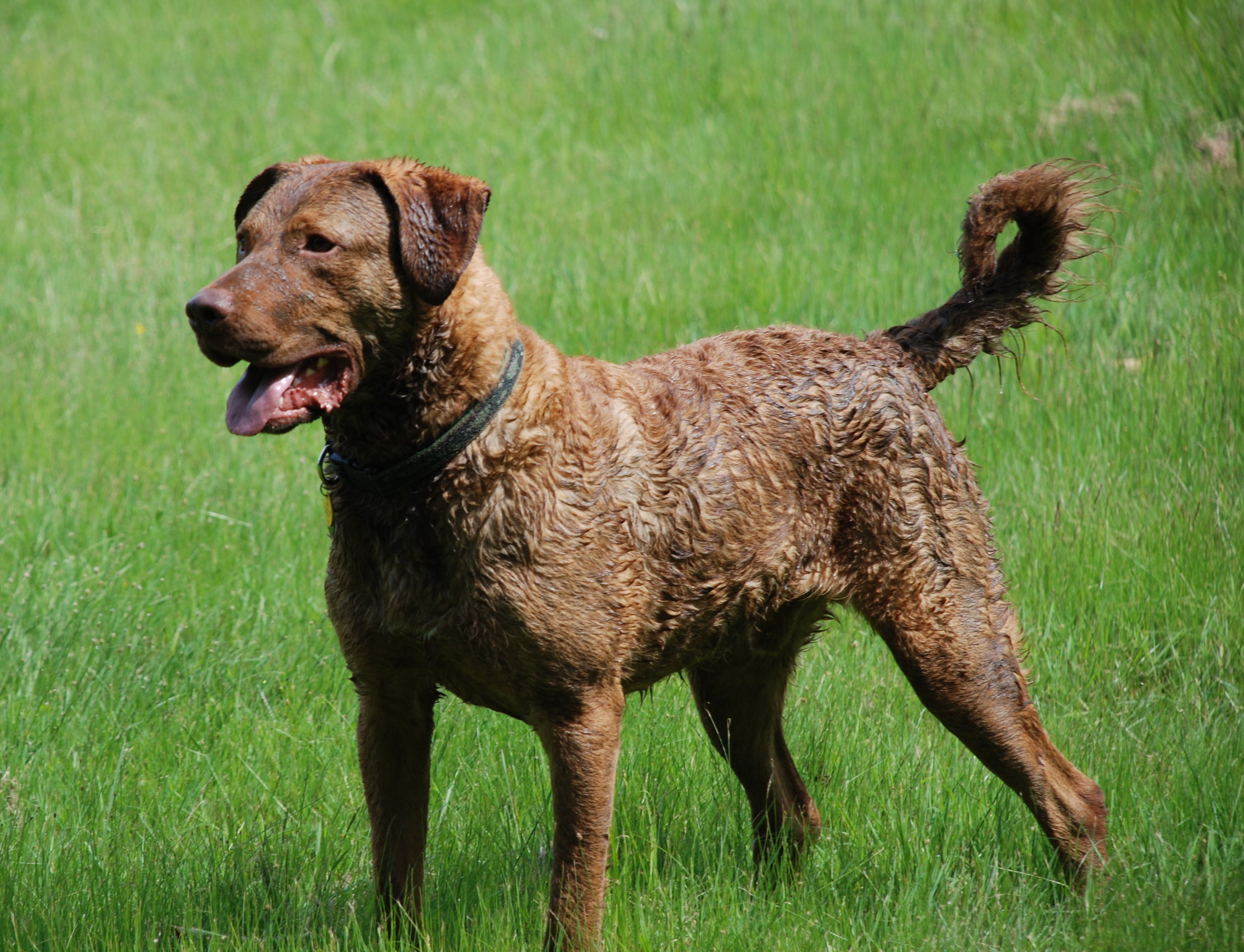
Amazing toughness, endurance, stamina, and adaptability make this a popular dog. It is probably the Chesapeake's coat, which is water and weather proof, that allows it to face the cold and wet undaunt-ingly. Thus, this gives him an advantage over other breeds. His red-tan color matches the marshland, giving him fine cover.
Chesapeakes are known for their stubbornness. They make fine watch dogs and take good care of their "family." They are serious, quiet, and very good companions.
The Chesapeake Bay area has been famous for its first-rate duck hunting ever since the first settlers set foot on shore. Retrievers have always been in demand by the Bay and, for many years, each hunter simply used the best dog he could find bred from other dogs who worked well. The Chesapeake dog was not an overnight creation, taking much of the 19th century to develop.
The oft-repeated story of the Chesapeake Bay Retriever breed springing from two dogs saved from a shipwrecked brig is probably another doggy "tale." These two dogs, "Canton," a black female, and "Sailor," a dingy red male with yellow eyes, were probably of the early smaller Newfoundland type and certainly did contribute to the breed. But the fact that they were never bred to each other assures that there were other wellsprings. References point to imported Red Winchesters from Ireland, perhaps bearing some relationship to the breeds which spawned the Irish Water Spaniel. By the last third of the 1800s, owners had formed an organization to promote and standardize the "Chesapeake Bay Ducking Dog." Type was still a variant, with the modern breed taking shape over the next 20 years.
The Chesapeake Bay Retriever dog was a favorite of the commercial duck hunter who shot for the restaurant and market trade in the late 1800s and early 1900s. Well-documented records chronicle dogs who averaged a thousand ducks each fall. The icy water and rough waves of the saltwater bay necessitated a dog tough in mind and body who lived to retrieve. And the tougher the conditions, the more the Chessie seemed to enjoy the hunt.
The "dead grass" color was preferred, to provide a camouflage that blended with the fall landscape. His coat is very dense and harsh with an almost oily texture that sheds water and insulates from the wet and cold. The head has a tendency to be smoother than the rest of the body; just a hint of the possible stem to the European water dogs like the Curly Coated Retriever, Wetterhound and Irish Water Spaniel. Described as "utilitarian rather than beautiful" and "about as sensitive as a Sherman tank," the breed attracts serious duck hunters.
Bearing the reputation as a hard head, he retains the mental toughness and independent sin-gle-mindedness so necessary for his early work. Once the Chesapeake Bay retriever knows who is giving the orders, he is a hard and willing worker. There are excellent breed members in obedience and field trials, as well as weekend gunners' companions. This is a devoted family dog who loves children. Although most modern families could hardly provide the kind of work performed by one early dog, who "all his life worked an average of five days of every seven," it is necessary to provide a Chesapeake with adequate exercise and some kind of job to make him—and consequently his owner—content.