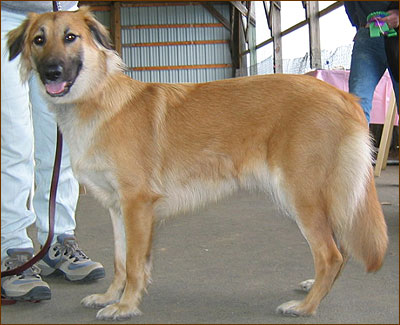
COUNTRY: USA
WEIGHT: 65-90 pounds
COAT: Short, smooth, dense
COLOR: Tawny
GROUP: Northern
This sledding dog is an American creation, dating from 1915. Arthur Walden wanted to create a sled dog that had both the speed of Huskies and the strength of the larger sled dogs. He used his lead dog, "Chinook," meaning warm winds, as the keystone sire. Chinook, according to Walden, was "half-bred Eskimo" through his dam, whose pedigree led back to Admiral Robert E. Peary's lead dog on his North Pole expedition. Chinook's sire was ". . . mongrel ... a trace of Saint Bernard."
In 1922 Walden's Chinook team beat three others to win the first Eastern International dog-sled race. Walden was asked to be in charge of the teams on Admiral Richard E, Byrd's 1929 Antarctic expedition, and Chinook went with his master. The Admiral wrote in Little America that the dogs he prized most highly were the Chinooks. He said, ". . . Walden's team was the backbone of our transport." Loads averaged a remarkable 150 pounds per dog. Chinook reached a sorrowful end on that trip, according to Admiral Byrd. ... the saddest . . . was the loss of Walden's famous lead dog, Chinook. Chinook was Walden's pride, and there was no doubting the fact that he was a great dog. He was old when brought to the Antarctic, too old for hard, continuous labor, and Walden used him as a kind of shock troop, throwing him into a team when the going turned very hard. Then the gallant heart of the old dog would rise above the years and pull with the glorious strength of a three-year-old. The affection between him and Walden was a beautiful thing to see: one sensed that each knew and understood the other perfectly, and it was Walden's rare boast that he never needed to give Chinook an order: the dog knew exactly what had to be done. A few days after his twelfth birthday, Chinook disappeared. We searched the camp for him, without success; in the trampled snow about the ship, it was impossible to find his tracks. . . . Whether he walked out alone to die, because his days of service were done, is something I cannot vouch for: this was the romantic theory advanced by several of the men. At any rate, his body was never found. ... Ah* this was a deep disappointment to Walden, who wanted to bury Chinook in his harness.
No comments:
Post a Comment